Category: news

  • TOPP FOUNDATION DONATES $20,000 TO CURE-FOCUSED TYPE ONE DIABETES RESEARCH

    TOPP FOUNDATION DONATES $20,000 TO CURE-FOCUSED TYPE ONE DIABETES RESEARCH

    In recognition of World Diabetes Day on November 14, 2021, TOPP Foundation, a local type 1 diabetes (T1D) nonprofit, made a $20,000 donation to the Diabetes Research Institute (DRI). All donations to DRI go directly towards innovative medical research aimed at curing type 1 diabetes.

    “This $20,000 donation is the third consecutive year we have donated to the Diabetes Research Institute. Despite COVID-19 and being unable to fundraise like previous years, TOPP remains dedicated to its partnership with the DRI and their commitment to cure Type 1 Diabetes. Thanks to our generous supporters, we are proud that our total endowment to the DRI since 2019 is now $90,000 and is goes directly to curing type 1 diabetes. We are grateful our donation will help fund viable research and we thank the DRI for making significant progress in helping to cure type 1 diabetes.” -Christine Gunsiorowski, TOPP Foundation Co-Founder & President.

    Tom Karlya, Senior Vice President for the Diabetes Research Institute Foundation, and a parent to two children living with type 1 diabetes, stated; “In as much as we are so grateful to those in the TOPP Foundation, equally rewarding is watching this relationship grow. These are a group of parents that are in their community outreaching, teaching, helping those living with type one diabetes. Them tending to the caring of today and looking to the Diabetes Research Institute for the cure to come, makes a great partnership. We cherish it.”

    Due to COVID-19, this donation to the DRI is smaller than in years past since both of their big annual fundraisers, Designer Bag Bingo and Cocktails for a Cure, were canceled in 2021 for the second year in a row due to COVID-19. TOPP is hopeful to be able to resume these popular fundraising events in 2022. TOPP raised the money for this donation in part by small fundraisers throughout the last year and a Trivia Night fundraiser that this past October.

    About TOPP

    TOPP Foundation (Type One Parent Project), is a local nonprofit founded in 2016 by three mothers who each have a son with Type One Diabetes. TOPP’s mission is to bring families together to support each other and to raise awareness and funds to accelerate research that leads to a cure. TOPP supports the T1D community in multiple ways. TOPP offers a monthly T1D parent support group, hosts family friendly social events for families living with T1D, organizes monthly luncheons, and holds successful fundraising campaigns twice a year. Additionally, in 2018, the organization created the TOPP Camp Scholarship Program. This program enhances the quality of life for youth living with the daily challenges of T1D by providing financial assistance to parents who would like their children to experience the joy of overnight summer camp.

    As of today, TOPP has donated a total of $138,000 directly to cure research. These funds have gone to the Diabetes Research Institute and to JDRF’s Fund a Cure Program. For information about TOPP Foundation, visit www.toppfoundation.org or email info@toppfund.org.

    About the Diabetes Research Institute

    The Diabetes Research Institute at the University of Miami Miller School of Medicine leads the world in cure-focused research. As one of the largest and most comprehensive research centers dedicated to curing diabetes, the DRI is aggressively working to develop a biological cure by restoring natural insulin production and normalizing blood sugar levels without imposing other risks. Researchers have already shown that transplanted islet cells allow patients to live without the need for insulin therapy. Some study participants have maintained insulin independence for more than 10 years. The DRI is building upon these promising outcomes through its BioHub strategy, a multidisciplinary, three-pronged approach for addressing the major challenges that stand in the way of a cure: eliminate the need for anti-rejection drugs, reset the immune system to block autoimmunity, and develop an unlimited supply of insulin-producing cells. For more information, please visit DiabetesResearch.org.

    About T1D

    Type 1 Diabetes, once known as juvenile diabetes, is an autoimmune disease that occurs when the body’s immune system attacks and destroys the insulin-producing cells in in the pancreas. Insulin is a hormone that enables people to get energy from food and is essential to survival. Although the names are similar, it is a vastly different disease then the more common type 2 diabetes. Its onset has nothing to do with diet or lifestyle. There is nothing you can do to prevent T1D and—at present—nothing you can do to get rid of it. Despite active research, type 1 diabetes currently has no cure. T1D strikes both children and adults at any age. It comes on suddenly, causes dependence on injected or pumped insulin for life, and carries the constant threat of devastating complications.
  • TOPP FOUNDATION DONATES $10,000 TO CURE-FOCUSED TYPE ONE DIABETES RESEARCH

    TOPP FOUNDATION DONATES $10,000 TO CURE-FOCUSED TYPE ONE DIABETES RESEARCH

    On November 30, 2022, in recognition of National Diabetes Awareness Month, TOPP Foundation, a local type 1 diabetes (T1D) nonprofit, made a $10,000 donation to the Diabetes Research Institute (DRI). “This is the fourth consecutive year we have donated to the DRI. Since all donations to the DRI go directly towards research aimed at curing type 1 diabetes, our donation of $10,000 will help in the search for a cure. Due to our generous supporters, our total endowment to the DRI since 2019 is now $100,000! We are proud that these funds have gone directly to cure research and we thank everyone who has supported our small nonprofit since 2016.” – Christine Gunsiorowski, TOPP Foundation Co-Founder & President.

    Tom Karlya, Senior Vice President for the Diabetes Research Institute Foundation, stated; “We cherish the partnership we have with TOPP Foundation, and being a father to two children living with T1D, it is so personally special to me that 3 moms started this organization to help fund a cure. The big news this year was surely the first drug approved as a disease-modifying therapy for type 1 diabetes. The DRI participated in the studies for this drug (teplizumab) and continues to be involved in multiple studies in this space. It is due to individuals and groups like TOPP Foundation, that our work can continue, and we will not stop until that cure is found.”

    TOPP Foundation (Type One Parent Project) is a nonprofit founded in 2016. TOPP’s mission is to raise awareness of the disease and to support local families living with the daily challenges of T1D. Since 2016, TOPP has held monthly T1D parent meetups and hosted many social events for T1D families. In 2018, the organization created the TOPP Camp Scholarship Program. This program enhances the quality of life for youth living with T1D by providing financial assistance to attend specialized overnight diabetes camps. Additionally, in 2022, TOPP Foundation’s Higher Education Scholarship was launched to provide financial assistance to local high school seniors with T1D who are pursuing higher education at a two-or four-year college/university, trade, or vocational school. These scholarships recognize the hard work, strength, and resilience these students display every day as they cope with a relentless chronic illness. As of today, TOPP has donated a total of $148,000 directly to cure research. These funds have gone to the Diabetes Research Institute and to JDRF’s Fund a Cure Program. For information about TOPP Foundation or if you would like to make a donation, please visit www.toppfoundation.org or email christine@toppfund.org.

    The Diabetes Research Institute at the University of Miami Miller School of Medicine is one of the largest and most comprehensive research centers dedicated to curing diabetes. The DRI is aggressively working to develop a biological cure by restoring natural insulin production and normalizing blood sugar levels without imposing other risks. Researchers have already shown that transplanted islet cells allow patients to live without the need for insulin therapy. Some study participants have maintained insulin independence for more than 10 years. The DRI is building upon these promising outcomes through its BioHub strategy, a multidisciplinary, three-pronged approach for addressing the major challenges that stand in the way of a cure: eliminate the need for anti-rejection drugs, reset the immune system to block autoimmunity, and develop an unlimited supply of insulin-producing cells.

    Type 1 Diabetes is an autoimmune disease that occurs when the body’s immune system attacks and destroys the insulin-producing cells in the pancreas. Insulin is a hormone that enables people to get energy from food and is essential to survival. Although the names are similar, it is a vastly different disease than the more common type 2 diabetes. T1D has nothing to do with diet or lifestyle. It causes dependence on injected or pumped insulin for life and carries the constant threat of devastating complications. There is nothing you can do to prevent T1D and—at present—there is no cure. T1D strikes both children and adults at any age and symptoms can develop in a few weeks or months and can be severe. Seek medical care if you or your child are experiencing any combination of the following symptoms: excessive thirst, frequent urination, excessive hunger, weight loss, headaches, blurry vision, and fatigue. If a diagnosis is delayed, untreated T1D can be life-threatening.

    You need to add a widget, row, or prebuilt layout before you’ll see anything here. 🙂
  • TOPP Foundation Donates $40,000 to T1D Cure Research

    TOPP Foundation Donates $40,000 to T1D Cure Research

    TOPP Foundation, a local type 1 diabetes nonprofit, made a $40,000 donation to the Diabetes Research Institute.

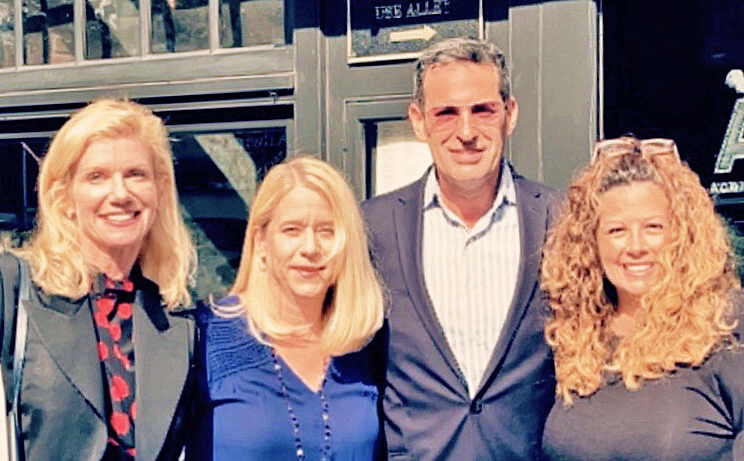
    (left to right) TOPP Co-founders: Christine Gunsiorowski, Kim McCleary, and Alli Curro
    (left to right) TOPP Co-founders: Christine Gunsiorowski, Kim McCleary, and Alli Curro (Photo credit: TOPP Foundation )

    TOPP Foundation (Type One Parent Project), a local type 1 diabetes (T1D) nonprofit, made a $40,000 donation to the Diabetes Research Institute (DRI) on October 5, 2020. All donations to DRI go directly towards cutting-edge medical research aimed at curing type 1 diabetes.

    While people with Type 1 Diabetes do not have a higher risk of contracting COVID-19, they could be at a greatly increased risk of serious complications from any virus or infection. Now, more than ever, TOPP Foundation stands committed to continuing their partnership with DRI because of their commitment to develop a biological cure for diabetes and freeing countless adults and children from the daily burden of this relentless chronic illness.

    “This $40,000 donation is the largest one-time donation we have made since TOPP Foundation began in 2016. Thanks to our generous supporters, we are proud that our total endowment to the DRI is now $70,000 and is aimed directly at curing type 1 diabetes.”- Christine Gunsiorowski, TOPP Foundation Co-Founder & President.

    Tom Karlya, Senior Vice President for the Diabetes Research Institute Foundation, and a parent to two children living with type 1 diabetes, stated; “In as much as we are so grateful to those in the TOPP Foundation, equally rewarding is watching this relationship grow. These are a group of parents that are in their community outreaching, teaching, helping those living with type one diabetes. Them tending to the caring of today and looking to the Diabetes Research Institute for the cure to come, makes a great partnership. We cherish it.”

    TOPP raised the money in part by hosting their annual Cocktails for a Cure fundraiser last Fall on November 2, 2019. TOPP’s 6th annual Cocktails for a Cure fundraiser that was scheduled for this November was cancelled due to COVID-19 and the social distancing restrictions. Over the past 5 years, this fundraiser and their annual designer bag bingo fundraiser has allowed TOPP to provide support to local T1D families and make significant donations to cure-focused research, such as this $40,000 donation to the Diabetes Research Institute.

  • TOPP FOUNDATION DONATES $10,000 TO T1D CURE RESEARCH FOR THE 4TH CONSECUTIVE YEAR

    TOPP FOUNDATION DONATES $10,000 TO T1D CURE RESEARCH FOR THE 4TH CONSECUTIVE YEAR

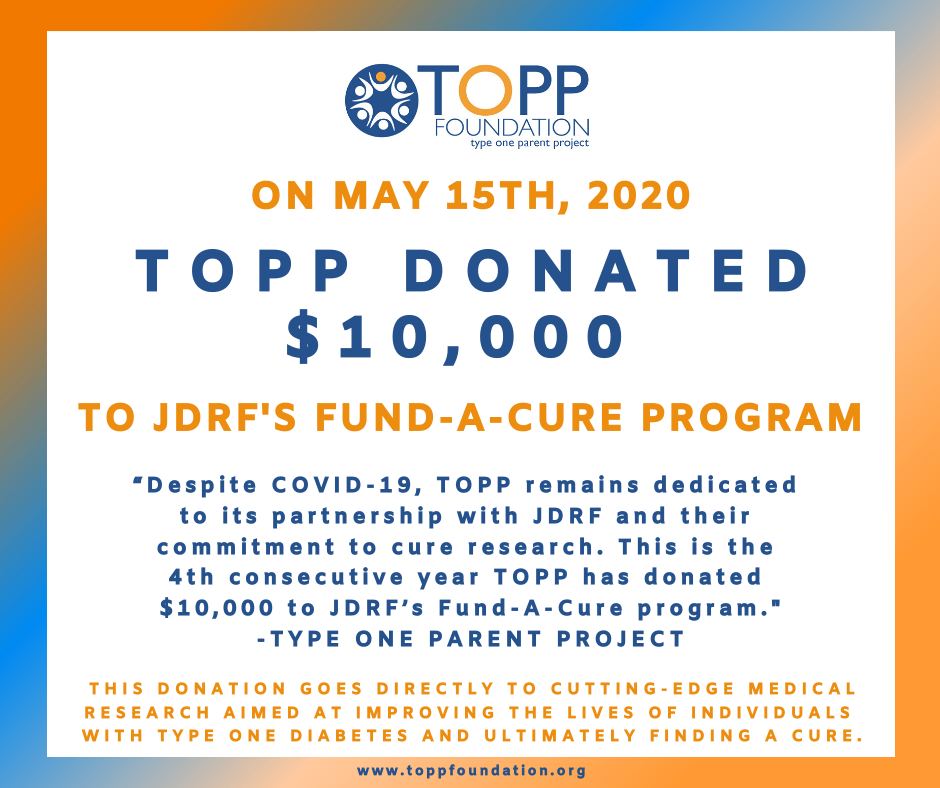
    The Type One Parent Project (TOPP) Foundation made a $10,000 donation to the Juvenile Diabetes Research Foundation’s (JDRF’s) Fund-A-Cure program on May 15, 2020.  In the past, this donation has been made in conjunction with the JDRF Greater Delaware Valley Chapter’s Spring Promise Ball, which was indefinitely postponed this year due to the COVID-19 pandemic.

    “Despite COVID-19, TOPP remains dedicated to its partnership with JDRF and their commitment to cure research. This is the 4th consecutive year TOPP has donated $10,000 to JDRF’s Fund-A-Cure program. We are committed to continuing our mission to contribute to cure research and to support families living with the daily challenges of type one diabetes.” -Christine Gunsiorowski, TOPP Foundation Co-Founder & President.”

    All donations to Fund-A-Cure go directly towards cutting-edge medical research aimed at improving the lives of individuals with Type 1 Diabetes (T1D) and ultimately finding a cure. TOPP raised the money by hosting their annual Cocktail’s for a Cure fundraiser last Fall.

    TOPP’s commitment to finding a cure for T1D and freeing adults and children from the daily burden of this relentless chronic illness is more important than ever.  While people with T1D do not have a higher risk of contracting COVID-19 or any other virus, they have a greatly increased risk of serious complications, including death, from any virus or infection.

    Additionally, the medical costs of T1D can be daunting and add further financial hardship to families, especially during this time of economic uncertainty. TOPP is helping to supply nonprescription low blood sugar necessities to local families struggling with their finances. For more information about this program or to donate supplies, please contact Kim McCleary at kim@toppfund.org.


  • Highlights of 2019 from TOPP Foundation

    Highlights of 2019 from TOPP Foundation

    Dear T1D Families and TOPP Supporters,

    Thank you all for making 2019 such an exciting and successful year!! Whether you have donated, attended or volunteered for an event, or even just gave us a shout out of encouragement, we appreciate you!

    – Christine Gunsiorowski, Co-founder and President

    Click Here to Read the Latest Newsletter


  • TOPP Foundation Donates $30,000 To Cure-Focused Type One Diabetes Research

    TOPP Foundation Donates $30,000 To Cure-Focused Type One Diabetes Research

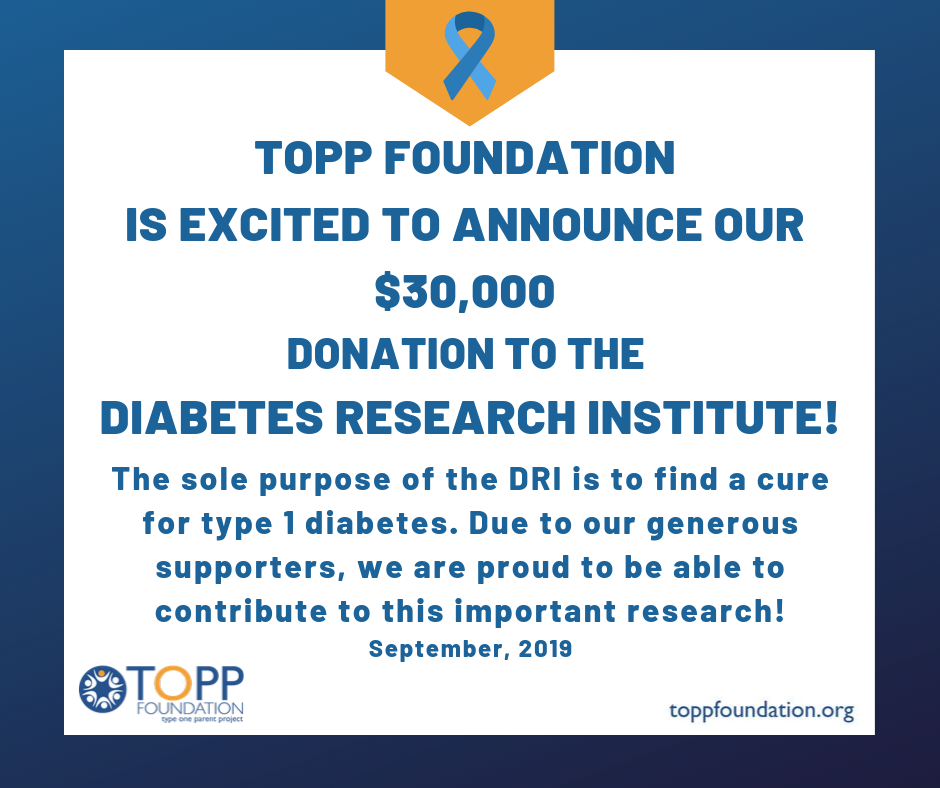
    TOPP Foundation (Type One Parent Project), a local type 1 diabetes (T1D) nonprofit, made a $30,000 donation in support of the Diabetes Research Institute on September 19th.

    All donations go directly towards cutting-edge medical research aimed at curing type1 diabetes.

    “This is the largest one-time donation TOPP has made to date. We are proud to be able to contribute to cure research and to support local families living with the daily challenges of type 1 diabetes,” said Christine Gunsiorowski, TOPP Foundation Co-Founder and President.

    PHOTO CAP:  Pictured from left, Jennifer Joyce, DRIF National Director, Philanthropy; Christine Gunsiorowski, Co-founder and President of TOPP; Dr. Juan Dominguez-Bendala, Director of Stem Cell Development for Translational Research at the Diabetes Research Institute; Kim McCleary, Co-founder and Vice-President of TOPP.

    Tom Karlya, Senior Vice President for the Diabetes Research Institute Foundation, and a parent to two children living with type 1 diabetes, stated, “We are both grateful and thrilled to begin this relationship with TOPP Foundation. The sole purpose of the Diabetes Research Institute is to find a cure for diabetes. TOPP is made up of parents, like myself, who strive to help find a cure once and for all for our kids. It is a goal we share, and we hope this initial donation is the beginning of a partnership that may continue for years.”

    TOPP raised the money in part by hosting their annual Cocktails for a Cure fundraiser last fall.

    TOPP’s fifth annual Cocktails for a Cure fundraiser will be held on Saturday, November 2nd, 7:00 to11:00pm, at The Bucks Club, 2600 York Road in Jamison.

    Tickets are $75 per person.

    Over the past four years, the fundraiser has successfully allowed TOPP to provide support to local T1D families and make significant donations to cure-focused research, such as the $30,000 donation to the Diabetes Research Institute.

    Cocktails for a Cureis a great evening filled with music, dancing, silent auctions, raffles, an open buffet and, of course, cocktails!

    To purchase tickets visit www.toppfoundation.org.

    TOPP Foundation is a local nonprofit founded in 2016 by three mothers who each have a son with Type One Diabetes.

    TOPP’s mission is to support and connect the local T1D community and raise funds supporting efforts to find a cure.

    The local T1D community is supported by TOPP in multiple ways. TOPP hosts a T1D parent support group, with occasional speakers, on the third Tuesday of each month at 7:30pm in the Central Bucks Ambulance & Rescue Building at 455 East Street in Doylestown. They also host family-friendly social events for families living with T1D, organize monthly luncheons, and hold successful fundraising campaigns twice a year.

    In addition, the TOPP Camp Scholarship Program provides financial assistance to families wishing to send children with Type One Diabetes to a specialized diabetes summer camp.

    Children with T1D are often unable to attend overnight summer camp because their disease requires 24-hour attention.

    TOPP understands that the medical costs of T1D can be daunting and a specialized camp can be a further financial hardship.

    For information and to learn more about TOPP Foundation, visit www.toppfoundation.org or email christine@toppfund.org.

    The Diabetes Research Institute at the University of Miami Miller School of Medicine leads the world in cure-focused research.

    As one of the largest and most comprehensive research centers dedicated to curing diabetes, the DRI is aggressively working to develop a biological cure by restoring natural insulin production and normalizing blood sugar levels without imposing other risks. Researchers have already shown that transplanted islet cells allow patients to live without the need for insulin therapy.

    Some study participants have maintained insulin independence for more than 10 years.

    The DRI is now building upon these promising outcomes through its BioHub strategy, a multidisciplinary, three-pronged approach for addressing the major challenges that stand in the way of a cure: eliminate the need for anti-rejection drugs, reset the immune system to block autoimmunity, and develop an unlimited supply of insulin-producing cells.

    For more information, visit DiabetesResearch.org, call 1-800-321-3437, or tweet @Diabetes_DRI.

    Type 1 diabetes is an autoimmune disease in which a person’s pancreas stops producing insulin, a hormone that enables people to get energy from food.

    It occurs when the body’s immune system attacks and destroys the insulin-producing cell in in the pancreas.

    Its onset has nothing to do with diet or lifestyle.

    There is nothing you can do to prevent T1D and – at present – there is no cure.

    T1D strikes both children and adults at any age.

    It comes on suddenly, causes dependence on injected or pumped insulin for life, and carries the constant threat of devastating complications.

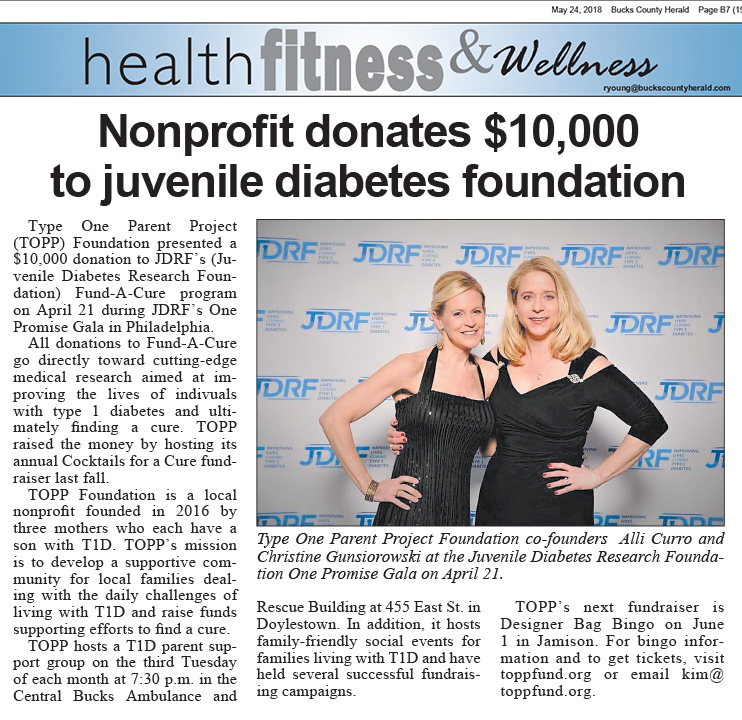
  • Bucks County Herald: Nonprofit donates $10,000 to juvenile diabetes foundation

    Bucks County Herald: Nonprofit donates $10,000 to juvenile diabetes foundation

    Type One Parent Project (TOPP) Foundation presented a $10,000 donation to JDRF’s (Juvenile Diabetes Research Foundation) Fund-A-Cure program on April 21 during JDRF’s One Promise Gala in Philadelphia. All donations to Fund-A-Cure go directly toward cutting-edge
    medical research aimed at improving the lives of indivuals with type 1 diabetes and ultimately finding a cure. TOPP raised the money by hosting its annual Cocktails for a Cure fundraiser last fall.

    TOPP Foundation is a local nonprofit founded in 2016 by three mothers who each have a  son with T1D. TOPP’s mission is to develop a supportive community for local families dealing with the daily challenges of living with T1D and raise funds supporting efforts to find a cure.

    TOPP hosts a T1D parent support group on the third Tuesday of each month at 7:30 p.m. in the Central Bucks Ambulance and Rescue Building at 455 East St. in Doylestown. In addition, it hosts family-friendly social events for families living with T1D and have
    held several successful fundraising campaigns.

    TOPP’s next fundraiser is Designer Bag Bingo on June 1 in Jamison.

  • The Intelligencer: Bucks County-based TOPP Foundation helping kids, families dealing with Type 1 diabetes

    The Intelligencer: Bucks County-based TOPP Foundation helping kids, families dealing with Type 1 diabetes

    Three Bucks County moms of kids with Type 1 diabetes have created a nonprofit to help other families dealing with the disease.

    Sarah Moore is a busy girl.

    On Sundays, she swims; Mondays, she goes to dance; Thursdays, she has hip-hop class. She plays basketball and soccer, depending on the season. She goes to kindergarten during the week, and she’s learning to play guitar.

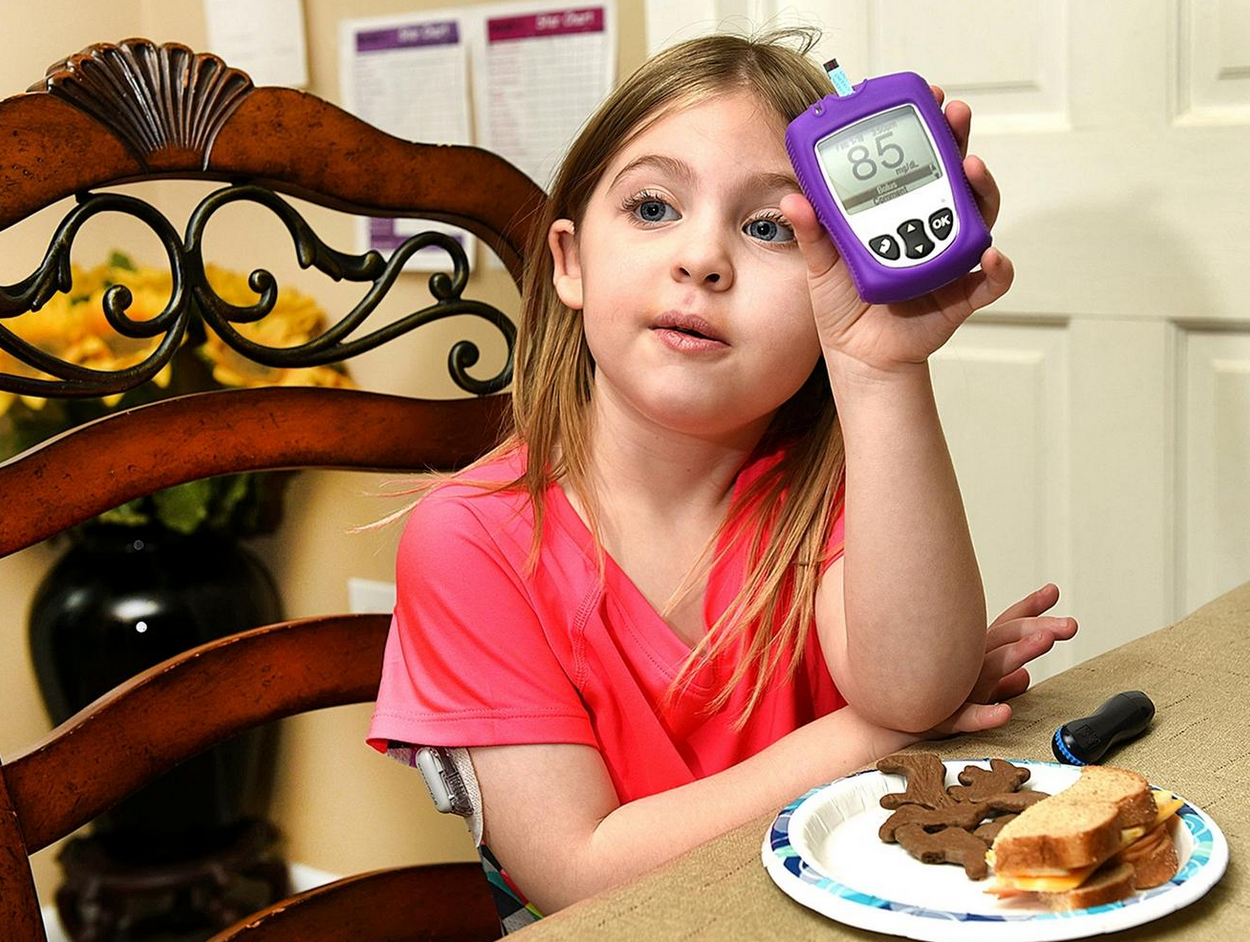
    But every day, multiple times a day — even in the middle of the night — the 6-year-old New Britain Township girl, with help from her family members, has to check her blood glucose level to make sure it’s within a safe range.

    “There’s this little poker — it’s tiny — and there’s this button on the top, and there’s this little thing — I have to pull it back and press the blue button — and then blood just comes out,” Sarah said, describing the process of using a lancet to prick her finger so she can place a drop of blood on a test strip in her purple blood glucose meter.

    “Before I eat a meal, every day, even if I’m low, I still have to test it.”

    Sarah, who was diagnosed with Type 1 diabetes at 19 months old, now wears an insulin pump. The pump provides a steady amount of insulin around the clock through a tiny needle inserted under the skin. It calculates how much of the hormone she needs based on her blood glucose and how many carbs she eats.

    She also wears a continuous glucose monitor, a small patch on her upper arm that measures her level every few minutes and helps her mom and other family members keep track of her level using a smartphone app. Their alarms sound if it goes above or below set numbers.

    Managing Type 1 diabetes is still a lot of work, as Christine Gunsiorowski, Alli Curro and Kim McCleary know.

    After each had a son diagnosed with Type 1 diabetes in 2014, the Doylestown-area moms began fundraising for research and a cure. In 2016, they formed a nonprofit called the Type One Parent Project (TOPP) Foundation, with the goal of providing emotional support and guidance for Bucks and Montgomery County families like Sarah’s, and raise awareness of the disease.

    “It’s this constant juggling act,” Gunsiorowski said. “Some diseases you take medicine once a day, you can maybe forget about it for a couple of hours. Type 1 you can’t, and that’s really hard; that’s hard for adults and that’s really hard for kids.”

    Type 1 diabetes is an autoimmune disease that stops the pancreas from producing insulin, which regulates blood glucose, or sugar, and allows the body to use it for energy.

    Low blood glucose can lead to seizures, coma and even death, while high blood glucose, if untreated, can cause damage to nerves and organs, according to the JDRF, formerly called the Juvenile Diabetes Research Foundation.

    Type 1 is commonly associated with kids — hence the former name juvenile diabetes — but people can be diagnosed at any age. According to JDRF, 1.25 million Americans are living with the disease, including about 200,000 under age 20. The prevalence in that age group is on the rise as well — there was a 21 percent increase between 2001 and 2009.

    There is no cure for Type 1, and people cannot prevent or manage it with a healthy diet and exercise, like some can with Type 2 diabetes. Experts aren’t totally sure what triggers the autoimmune response that causes it, but Ken Rodenheiser, a registered nurse and certified diabetes educator in the Diabetes Center at Children’s Hospital of Philadelphia, explains to patients that the gene is always there.

    “It’s like an app on your phone that you never use. And then once that app opens up, you can never close it,” he said.

    Symptoms of the disease include frequent urination, fatigue, extreme hunger and thirst, and weight loss. But sometimes they go unnoticed or are attributed to another illness, increased activity or growth spurts.

    “Kids who don’t get to their primary care in time tend to get sicker and sicker and sicker,” Rodenheiser said. “It can get pretty serious.”

    Sarah, and McCleary’s son, Gage, then 9, both developed an emergency condition called diabetic ketoacidosis, in which their blood glucose levels were extremely high and their bodies were breaking down fat for energy, releasing harmful chemicals called ketones.

    “They told me at CHOP had I waited (to take her to the pediatrician) … she would not be here today or she would not be here today in this capacity,” Sheri Moore said, tears welling.

    Gunsiorowski’s son Ryan, then 14, and Curro’s son, Reagan, then 12, also were sent to CHOP with extremely high blood glucose levels.

    The hospital has a specially trained team of doctors, nurse practitioners, dieticians, social workers, nurses and others who work with kids and their families for several days after the initial diagnosis as their blood glucose levels are brought under control.

    “We put them through diabetes boot camp,” Rodenheiser explained.

    It can be overwhelming, McCleary said.

    “Everybody says when you’re first diagnosed, ‘This is going to be your new normal,’ ” she said, adding that it takes about a year to really understand what that means.

    There are lots of adjustments, including financial. Kids with Type 1 diabetes are eligible for Medicaid benefits in Pennsylvania regardless of income and even if their families have insurance, but it’s still an expensive disease. Sarah’s insulin pump cost $7,000, for example, so Moore is thankful it was covered.

    “Your life changes forever,” Curro said.

    During that first year, kids and families return to the hospital several times and meet with certified diabetes educators like Rodenheiser to make sure they feel confident managing the disease and have a plan for how to do it.

    Meeting other moms whose families were going through the same things helped Gunsiorowski “immensely,” so the support aspect of TOPP is a big priority for her.

    The group plans to expand its list of speakers and programs at monthly meetings this year, and they’re developing a mentoring program in which older kids and teens with Type 1 can help younger ones.

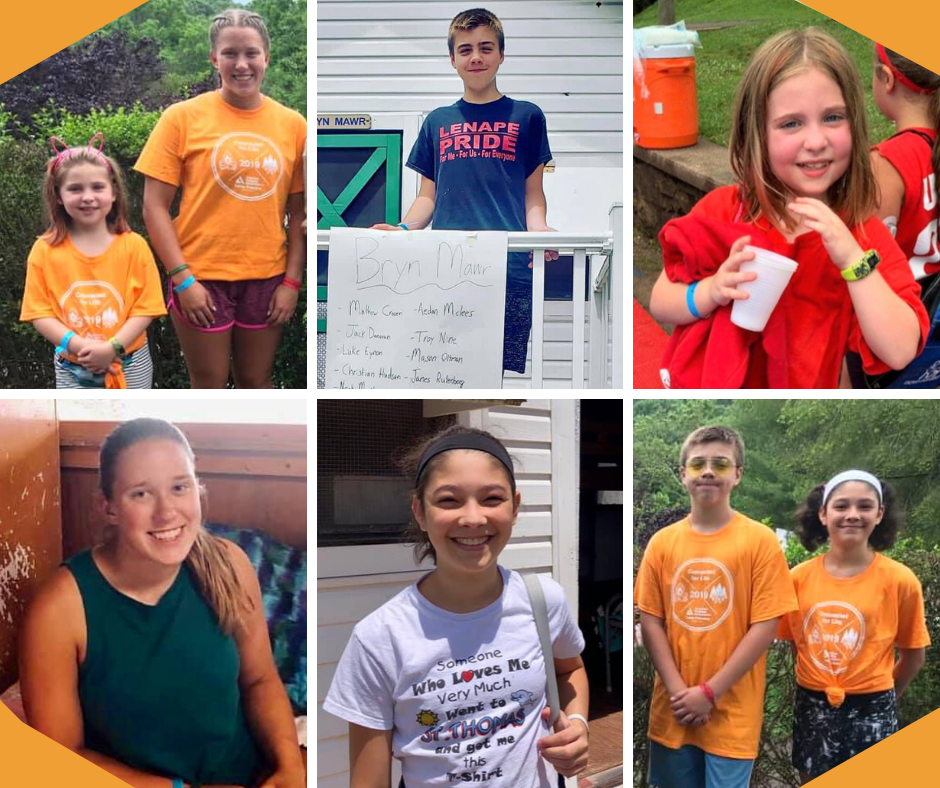
    Next month, TOPP will award several scholarships to families with a financial need so their kids can go to the American Diabetes Association’s Camp Freedom in Schwenksville, Montgomery County. The kids get medical attention and the experience of a week-long overnight camp — something that might not be possible otherwise.

    “It kind of normalizes diabetes so (the kids) feel a sense of ‘I’m not alone,’” Rodenheiser said. “You focus on being a kid before you focus on diabetes and blood sugars. That’s also very helpful with coping and for the parent when they see their kid able to manage and feel comfortable.”

    Even sleepovers at friends’ houses can be frightening for parents of kids with Type 1, Moore added. But she and the other moms stress that Type 1 doesn’t hold their kids back, and with all the technology and tools being developed, she is optimistic about a cure.

    ″(Sarah) can live life to the fullest and she will. She’ll live a life like any other kid,” Moore said, adding that she thinks the cure will comes before Sarah goes to college. “There is no difference between her and (her 8-year-old sister) Rachel. There’s no difference between her and the kid on the other side of the street. She’s got that one thing but every kid has that one thing.”